


Preface
Today’s Chongqing is sunny and not cold.
I got up in the morning, climbed the stairs three times, then made a cup of black coffee, and started a new day of hustle.
Hustling with Obsidian
Since I just started using Obsidian, I originally wanted to learn how to use the Tasks plugin in Obsidian and try to migrate some features from Microsoft TODO to Obsidian. After some tinkering, I found it difficult to use and gave up.
However, during my search for how to use Obsidian, I came across a nice blogWeichen Ink, where he wrote some useful content about Obsidian that made me want to bookmark it immediately. When I opened my browser bookmarks, I realized that I had actually bookmarked and followed many blogs before, but I found it hard to remember all the URLs of each blog, and I rarely took the initiative to click on them one by one to see what they had updated. Some blogs also did not provide email subscription options.
Until I saw that the homepage of that blog had an RSS subscription address.
Facing RSS
Actually, many years ago, many blogs provided something called 'RSS' subscription. Although I had seen the term 'RSS' in various places many years ago, I never really took the time to understand what it was and what benefits it could bring me.
At that moment, I suddenly realized that for so many years, I had not consciously filtered, organized, or curated my information sources.
I pondered:
- If I do not review, then what is the point of simply putting things I find interesting into my browser bookmarks?
- If I do not open various apps, then what is the point of following and bookmarking interesting content across different platforms?
Moreover, with various information platforms and apps now, each platform has its own built-in follow/bookmark tools. The one I use most often is the subscription within the platform, but when I don’t want to open that platform, I miss out on some content. Additionally, with so many platforms (X, Zhihu, Bilibili, Douyin, etc.), I have to switch back and forth between multiple apps, which is really inefficient.
At the same time, the platform's algorithm recommendation mechanism is becoming increasingly aggressive, making it actually less likely to capture clear, high-quality content on social platforms compared to the past.
Thus, I began to truly understand RSS and asked ChatGPT if there were any tools that could help me organize my information sources.
GPT told me that the complete concept of RSS is:
RSS (Really Simple Syndication) is a format for distributing web content that allows website publishers to package their updated content in a standardized XML format, enabling users to subscribe to this content through an RSS reader without having to directly visit each website.
The result was surprising; this was exactly what I wanted but had overlooked all along.
Recognizing Needs
At this point, I roughly sorted out what I truly wanted:
- Unified Entry: Gather information from different websites in one place to avoid switching back and forth between multiple apps or websites.
- Control Information: You can actively choose which information sources to subscribe to, rather than passively accepting algorithm recommendations.
- In-depth Reading: RSS readers typically provide a better reading experience and allow for easy note-taking, summarizing, and other operations.
- Efficiency Improvement: Only get updated content, saving time from browsing a lot of repetitive information.
Finding Solutions
Where there is a need, there will be corresponding tools.
After two hours of searching and comparing, I finally narrowed down the following tools:
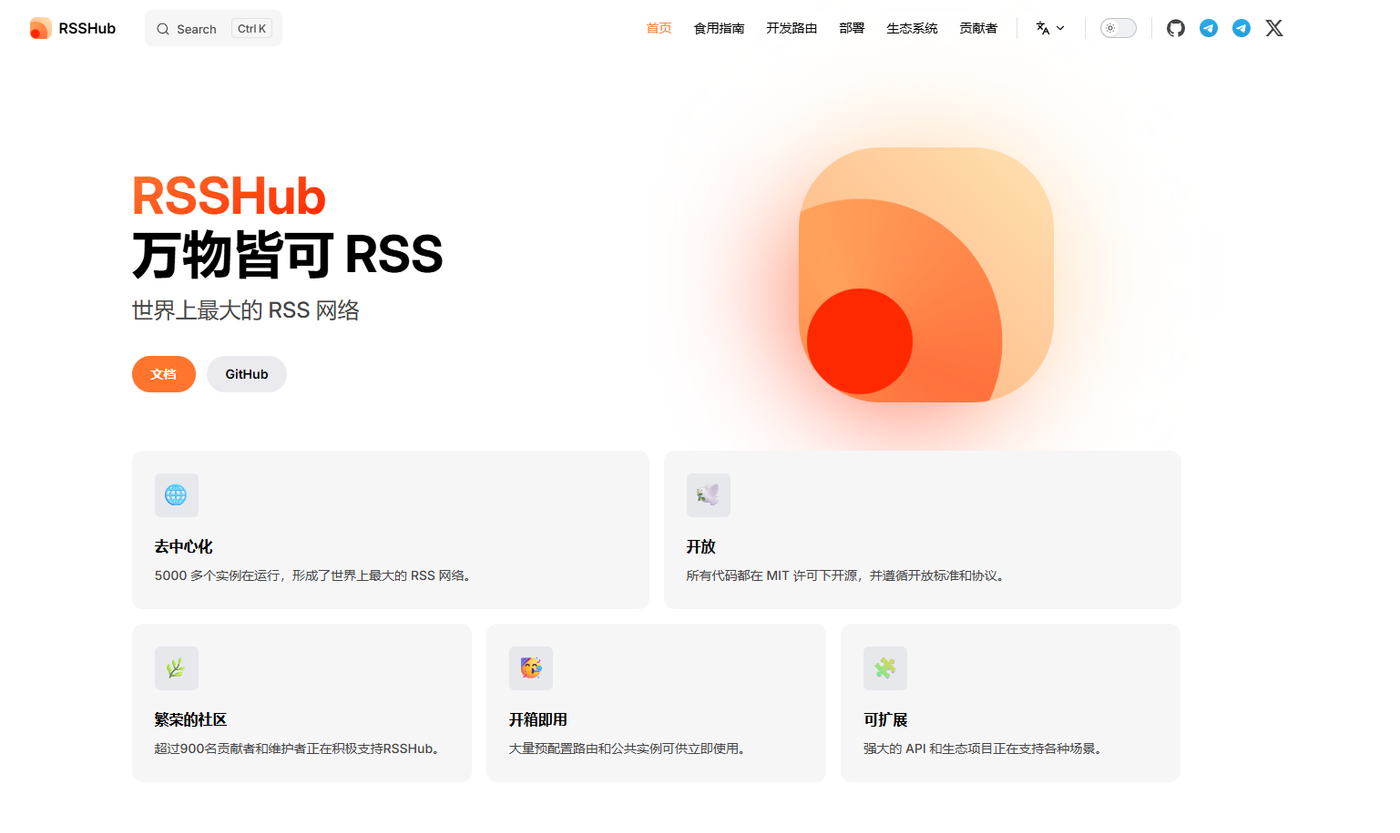
RSSHub: It can convert many information sources on the internet, whether social media posts, Zhihu columns, YouTube channels, etc., into RSS subscribable addresses.
Folo: A reader developed by the same author as RSSHub, supporting web/mobile/desktop.
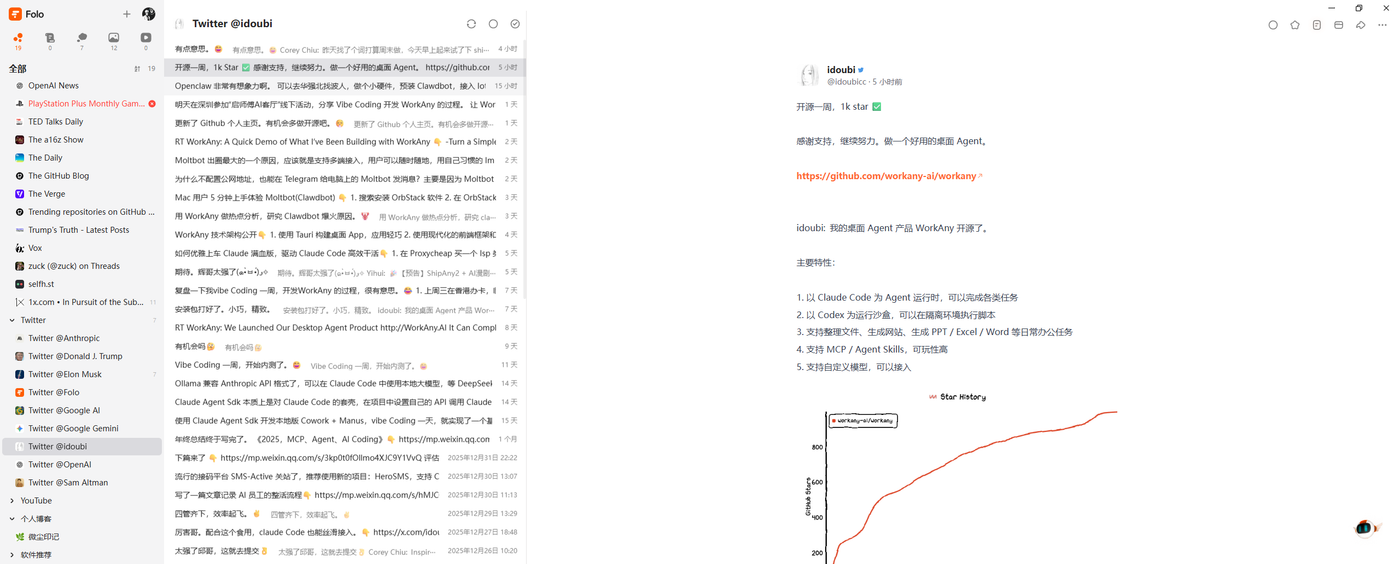
The above image shows the interface of Folo, where you can see that I have subscribed to the information stream of the independent developer “Idoubicc” on X.
Integrating with Obsidian
I solved the information source (RSSHub) and also solved reading (Folo).
The act of 'reading' allows my brain to interact with information, but I also need a way to handle the review and retention of information, and Obsidian is undoubtedly the best way.
If I use Folo's web version and also install the Obsidian Web Clipper browser extension, I can also highlight during the reading process or save this reading directly to my Obsidian workspace. Of course, you can also directly open the source URL of the information and save that URL to Obsidian.
Once key information enters my Obsidian workspace, I can also utilize Obsidian Copilot, using AI to interact further with the various information I have retained.
Conclusion
The emergence of AI has further inflated the information on the internet, and algorithm recommendations have made people fatigued, often pushing content that may not have real value, lowering my attention. RSS, however, allows me to regain control over information.
I truly do not want to be fed garbage by algorithms, nor do I want to fall into the trap of information silos.
By Yue Wu 2026-01-31